RESEED River Story Workshop Report by Cheryl Durrant & Nettie Hulme
Introduction
The RESEED River Story Workshop was held on Sunday 26th Feb 2023.
The workshop aimed to clarify, affirm and prioritise the actions needed to nurture RESEED as a vibrant, sustainable; place, space and community.
The RESEED River Story Report presents the key insights from the River Story Workshop. Additional insights from the online survey are incorporated. The report synthesis participant inputs -so comments may not appear verbatim. Any failure to read participant writing or intent is the authors.
Celebration
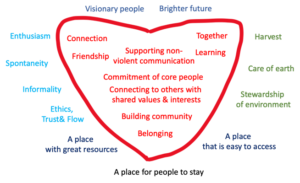
Participants celebrated many things about RESEED, including; space, place and community. Based on the responses from the day – community and people the beating heart of RESEED (Fig1.).
Fig 1. Celebration Responses
RESEED Today- Values, Pains & Gains
Participants were asked to individually reflect and record: (1) the values that they look for in RESEED (2) the gains or benefits they received from RESEED and (3) their unmet needs or “pains”. Based on the responses received it may be useful to visualise RESEED as a tree (Fig 2)
Fig 2. The RESEED Tree
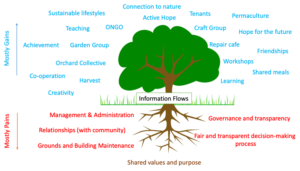
The gains (and things to celebrate) can be visualised as the canopy. Gains mostly come from the activities conducted by RESEED and the connections, learning, caring, and sharing, experiences derived from the activities.
As the RESEED tree stands now there is abundant growth in the canopy while the root and trunk system need more resources and care. Not unsurprisingly this is where most of the unmet leads lie.
The pains or unmet needs come from the foundational activities (the roots) that are needed to sustain the canopy. This is where too few people are doing too much work, or work that they do not enjoy. The tap root can be visualized as the shared values and purpose – and some participants felt that this was still not clear. Connecting the roots to the canopy – information flows (or fails to flow) through the trunk.
Some individual values are being “held in tension” . Values being in tension does not imply that any value is bad , or good – only that these values are pulling people and resources in different directions. Explicitly recognizing and resolving (or accepting) values in tension can help reduce conflict and make core purpose clearer.
Two sets of values in tension that are manifesting as critical pain points now are:
Importantly these new tasks are different things to different people. The new tasks to be started are often “fun” projects, but they also create additional administrative or management burdens (the things to say no to). Tensions are also being exacerbated by bottlenecks in information flows around decision making. Alternate decision-making and organising models such as a sociocracy model (discussed below) may provide a way forward in this instance.
Two sets of values in tension that may manifest as future critical pain points are:
While there is currently a. focus on clarifying vision and purpose additional work on developing the RESEED Business Model (discussed below) and making it transparent to everyone is one approach that could be useful in avoiding future tensions as the Centre grows.
RESEED Future – Blue Ocean Matrix
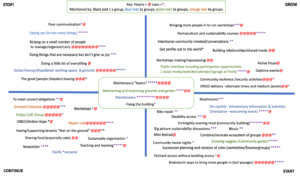
Looking to the future and working in four groups participants were asked to nominate activities that should stop, continue, grow or start. After completing the matrix participants were asked to vote on the activities that most resonated with them using a heart (represented below by the symbol (@) for heart or a. star (*). Fig 3 Below is the combined matrix from all four groups with responses that received no votes omitted. A larger version of Fig 3. is provided at Annex A.
Fig 3. Blue Ocean Matrix
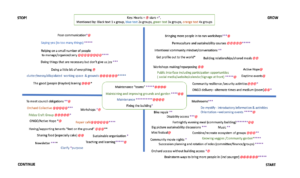
Responses that were similar have been combined. Responses that occurred in multiple quadrants have been placed in the most commonly occurring quadrant or in the case of maintenance related activities -set out in a box covering all four quadrants.
There is a lot happening here. Visualizing responses against the tree model there are potential action clusters around maintenance and appearance, information and interface and people and organization Fig 4.
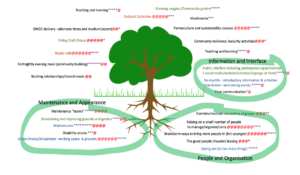
Fig 4. Blue Ocean Responses mapped to the RESEED Tree
These groupings are not exhaustive and many possible combinations may arise. Grouping responses is a useful tool for organising resources and work streams.
Some Tools to Explore
On Sociocracy (Nettie): The Sociocracy model is best suited to organization’s who want to self-govern based on the values of equality, trust and non-violent communication and is congruent with permaculture principles.
Its origins are in natural systems where each system is both autonomous and interconnected. Sociocracy builds on a set of simple rules. For example, a simple rule defines how to create a circle. The same rule then allows any circles to form a sub-circle, and the sub-circles to form sub-sub-circles and so on.
Decision-making builds on decision-making by the Quakers that have a strong commitment to inclusion and egalitarian values. Cybernetics: sociocracy uses feedback loops to learn about the impact of actions.
On Business Models (Cheryl): Clarity in an organisation needs to be more than just clarity of vision or purpose – there needs to be clarity about how the organisation operates- what is its business (or value) model? The RESEED business model is one of the most complex I have come across. It doesn’t exist neatly on a single page for ease of understanding or access. Some areas are clear, well developed and supported: others are opaque or underdeveloped/under resourced. The Business Model Canvas provides one approach to clarifying and refining the business model. Griffith University has developed a handy guide for using the business model canvas for social enterprises. Business Models Canvasses have also been developed for regenerative, socially oriented or nature based organisations.
Going Forth
It is recommended that participants reconvene in a root and branch design jam (timing TBA -probably in May) to work on actions from the River Journey Workshop. As an input to the design jam a business model for the current way of operating might be prepared (Cheryl will assist) Having a current business model available will help with discussions about resources and ensuring that aspirations are supported by capabilities
A design jam is a collaborative problem-solving activity normally run over two days (but can be a day because we have done the first two steps at our first workshop) which uses design tools (including brainstorming) to produce concrete actionable solutions (Nettie and Cheryl will co-facilitate). The advantage of this approach is that everyone works together at the same time and place so more ideas are generated and workstreams tend to be more aligned.
As an alternative, if timing for a design jam is difficult to arrange, is to start experimenting with a sociocracy model of engagement. In this approach RESEED would call for groups of volunteers to work on action areas, reporting back to a central steering circle. This approach would be more flexible regarding timings (Nettie will assist).
Or a mix of the two approaches could be adopted.
Annex A -Blue Ocean Matrix Responses Combined
Note: Includes only responses that gained one or more uptick (star or heart in the voting round).